Lesson · Numbers
Arabic Numbers 1 to 100
Here are all the Arabic numbers from 1 to 100, with the Arabic numeral, the Arabic word, an easy pronunciation and a listen button. Learn 1–10 and the tens first. After that, every other number follows one simple pattern.
Start here: 1 to 10
These ten words build almost every other number. Tap a card to hear it.
Arabic numbers 1–100 table
The pronunciation uses a simple key: ā ī ū are long vowels, ʿ is the letter ع (ʿayn), ḥ is a strong breathy h (ح), th is as in “think” (ث), kh is as in Scottish “loch” (خ), and ʾ is a short stop in the throat (ء).
| Number | Arabic word | Pronunciation | Listen |
|---|---|---|---|
| 1–10: the basic numbers | |||
| 1 ١ | وَاحِدٌ | wāḥidun | |
| 2 ٢ | اِثْنَانِ | ithnāni | |
| 3 ٣ | ثَلَاثَةٌ | thalāthatun | |
| 4 ٤ | أَرْبَعَةٌ | arbaʿatun | |
| 5 ٥ | خَمْسَةٌ | khamsatun | |
| 6 ٦ | سِتَّةٌ | sittatun | |
| 7 ٧ | سَبْعَةٌ | sabʿatun | |
| 8 ٨ | ثَمَانِيَةٌ | thamāniyatun | |
| 9 ٩ | تِسْعَةٌ | tisʿatun | |
| 10 ١٠ | عَشَرَةٌ | ʿasharatun | |
| 11–19: number + ʿashara | |||
| 11 ١١ | أَحَدَ عَشَرَ | aḥada ʿashara | |
| 12 ١٢ | اِثْنَا عَشَرَ | ithnā ʿashara | |
| 13 ١٣ | ثَلَاثَةَ عَشَرَ | thalāthata ʿashara | |
| 14 ١٤ | أَرْبَعَةَ عَشَرَ | arbaʿata ʿashara | |
| 15 ١٥ | خَمْسَةَ عَشَرَ | khamsata ʿashara | |
| 16 ١٦ | سِتَّةَ عَشَرَ | sittata ʿashara | |
| 17 ١٧ | سَبْعَةَ عَشَرَ | sabʿata ʿashara | |
| 18 ١٨ | ثَمَانِيَةَ عَشَرَ | thamāniyata ʿashara | |
| 19 ١٩ | تِسْعَةَ عَشَرَ | tisʿata ʿashara | |
| 20–29: twenty | |||
| 20 ٢٠ | عِشْرُونَ | ʿishrūna | |
| 21 ٢١ | وَاحِدٌ وَعِشْرُونَ | wāḥidun wa-ʿishrūna | |
| 22 ٢٢ | اِثْنَانِ وَعِشْرُونَ | ithnāni wa-ʿishrūna | |
| 23 ٢٣ | ثَلَاثَةٌ وَعِشْرُونَ | thalāthatun wa-ʿishrūna | |
| 24 ٢٤ | أَرْبَعَةٌ وَعِشْرُونَ | arbaʿatun wa-ʿishrūna | |
| 25 ٢٥ | خَمْسَةٌ وَعِشْرُونَ | khamsatun wa-ʿishrūna | |
| 26 ٢٦ | سِتَّةٌ وَعِشْرُونَ | sittatun wa-ʿishrūna | |
| 27 ٢٧ | سَبْعَةٌ وَعِشْرُونَ | sabʿatun wa-ʿishrūna | |
| 28 ٢٨ | ثَمَانِيَةٌ وَعِشْرُونَ | thamāniyatun wa-ʿishrūna | |
| 29 ٢٩ | تِسْعَةٌ وَعِشْرُونَ | tisʿatun wa-ʿishrūna | |
| 30–39: thirty | |||
| 30 ٣٠ | ثَلَاثُونَ | thalāthūna | |
| 31 ٣١ | وَاحِدٌ وَثَلَاثُونَ | wāḥidun wa-thalāthūna | |
| 32 ٣٢ | اِثْنَانِ وَثَلَاثُونَ | ithnāni wa-thalāthūna | |
| 33 ٣٣ | ثَلَاثَةٌ وَثَلَاثُونَ | thalāthatun wa-thalāthūna | |
| 34 ٣٤ | أَرْبَعَةٌ وَثَلَاثُونَ | arbaʿatun wa-thalāthūna | |
| 35 ٣٥ | خَمْسَةٌ وَثَلَاثُونَ | khamsatun wa-thalāthūna | |
| 36 ٣٦ | سِتَّةٌ وَثَلَاثُونَ | sittatun wa-thalāthūna | |
| 37 ٣٧ | سَبْعَةٌ وَثَلَاثُونَ | sabʿatun wa-thalāthūna | |
| 38 ٣٨ | ثَمَانِيَةٌ وَثَلَاثُونَ | thamāniyatun wa-thalāthūna | |
| 39 ٣٩ | تِسْعَةٌ وَثَلَاثُونَ | tisʿatun wa-thalāthūna | |
| 40–49: forty | |||
| 40 ٤٠ | أَرْبَعُونَ | arbaʿūna | |
| 41 ٤١ | وَاحِدٌ وَأَرْبَعُونَ | wāḥidun wa-arbaʿūna | |
| 42 ٤٢ | اِثْنَانِ وَأَرْبَعُونَ | ithnāni wa-arbaʿūna | |
| 43 ٤٣ | ثَلَاثَةٌ وَأَرْبَعُونَ | thalāthatun wa-arbaʿūna | |
| 44 ٤٤ | أَرْبَعَةٌ وَأَرْبَعُونَ | arbaʿatun wa-arbaʿūna | |
| 45 ٤٥ | خَمْسَةٌ وَأَرْبَعُونَ | khamsatun wa-arbaʿūna | |
| 46 ٤٦ | سِتَّةٌ وَأَرْبَعُونَ | sittatun wa-arbaʿūna | |
| 47 ٤٧ | سَبْعَةٌ وَأَرْبَعُونَ | sabʿatun wa-arbaʿūna | |
| 48 ٤٨ | ثَمَانِيَةٌ وَأَرْبَعُونَ | thamāniyatun wa-arbaʿūna | |
| 49 ٤٩ | تِسْعَةٌ وَأَرْبَعُونَ | tisʿatun wa-arbaʿūna | |
| 50–59: fifty | |||
| 50 ٥٠ | خَمْسُونَ | khamsūna | |
| 51 ٥١ | وَاحِدٌ وَخَمْسُونَ | wāḥidun wa-khamsūna | |
| 52 ٥٢ | اِثْنَانِ وَخَمْسُونَ | ithnāni wa-khamsūna | |
| 53 ٥٣ | ثَلَاثَةٌ وَخَمْسُونَ | thalāthatun wa-khamsūna | |
| 54 ٥٤ | أَرْبَعَةٌ وَخَمْسُونَ | arbaʿatun wa-khamsūna | |
| 55 ٥٥ | خَمْسَةٌ وَخَمْسُونَ | khamsatun wa-khamsūna | |
| 56 ٥٦ | سِتَّةٌ وَخَمْسُونَ | sittatun wa-khamsūna | |
| 57 ٥٧ | سَبْعَةٌ وَخَمْسُونَ | sabʿatun wa-khamsūna | |
| 58 ٥٨ | ثَمَانِيَةٌ وَخَمْسُونَ | thamāniyatun wa-khamsūna | |
| 59 ٥٩ | تِسْعَةٌ وَخَمْسُونَ | tisʿatun wa-khamsūna | |
| 60–69: sixty | |||
| 60 ٦٠ | سِتُّونَ | sittūna | |
| 61 ٦١ | وَاحِدٌ وَسِتُّونَ | wāḥidun wa-sittūna | |
| 62 ٦٢ | اِثْنَانِ وَسِتُّونَ | ithnāni wa-sittūna | |
| 63 ٦٣ | ثَلَاثَةٌ وَسِتُّونَ | thalāthatun wa-sittūna | |
| 64 ٦٤ | أَرْبَعَةٌ وَسِتُّونَ | arbaʿatun wa-sittūna | |
| 65 ٦٥ | خَمْسَةٌ وَسِتُّونَ | khamsatun wa-sittūna | |
| 66 ٦٦ | سِتَّةٌ وَسِتُّونَ | sittatun wa-sittūna | |
| 67 ٦٧ | سَبْعَةٌ وَسِتُّونَ | sabʿatun wa-sittūna | |
| 68 ٦٨ | ثَمَانِيَةٌ وَسِتُّونَ | thamāniyatun wa-sittūna | |
| 69 ٦٩ | تِسْعَةٌ وَسِتُّونَ | tisʿatun wa-sittūna | |
| 70–79: seventy | |||
| 70 ٧٠ | سَبْعُونَ | sabʿūna | |
| 71 ٧١ | وَاحِدٌ وَسَبْعُونَ | wāḥidun wa-sabʿūna | |
| 72 ٧٢ | اِثْنَانِ وَسَبْعُونَ | ithnāni wa-sabʿūna | |
| 73 ٧٣ | ثَلَاثَةٌ وَسَبْعُونَ | thalāthatun wa-sabʿūna | |
| 74 ٧٤ | أَرْبَعَةٌ وَسَبْعُونَ | arbaʿatun wa-sabʿūna | |
| 75 ٧٥ | خَمْسَةٌ وَسَبْعُونَ | khamsatun wa-sabʿūna | |
| 76 ٧٦ | سِتَّةٌ وَسَبْعُونَ | sittatun wa-sabʿūna | |
| 77 ٧٧ | سَبْعَةٌ وَسَبْعُونَ | sabʿatun wa-sabʿūna | |
| 78 ٧٨ | ثَمَانِيَةٌ وَسَبْعُونَ | thamāniyatun wa-sabʿūna | |
| 79 ٧٩ | تِسْعَةٌ وَسَبْعُونَ | tisʿatun wa-sabʿūna | |
| 80–89: eighty | |||
| 80 ٨٠ | ثَمَانُونَ | thamānūna | |
| 81 ٨١ | وَاحِدٌ وَثَمَانُونَ | wāḥidun wa-thamānūna | |
| 82 ٨٢ | اِثْنَانِ وَثَمَانُونَ | ithnāni wa-thamānūna | |
| 83 ٨٣ | ثَلَاثَةٌ وَثَمَانُونَ | thalāthatun wa-thamānūna | |
| 84 ٨٤ | أَرْبَعَةٌ وَثَمَانُونَ | arbaʿatun wa-thamānūna | |
| 85 ٨٥ | خَمْسَةٌ وَثَمَانُونَ | khamsatun wa-thamānūna | |
| 86 ٨٦ | سِتَّةٌ وَثَمَانُونَ | sittatun wa-thamānūna | |
| 87 ٨٧ | سَبْعَةٌ وَثَمَانُونَ | sabʿatun wa-thamānūna | |
| 88 ٨٨ | ثَمَانِيَةٌ وَثَمَانُونَ | thamāniyatun wa-thamānūna | |
| 89 ٨٩ | تِسْعَةٌ وَثَمَانُونَ | tisʿatun wa-thamānūna | |
| 90–100: ninety and one hundred | |||
| 90 ٩٠ | تِسْعُونَ | tisʿūna | |
| 91 ٩١ | وَاحِدٌ وَتِسْعُونَ | wāḥidun wa-tisʿūna | |
| 92 ٩٢ | اِثْنَانِ وَتِسْعُونَ | ithnāni wa-tisʿūna | |
| 93 ٩٣ | ثَلَاثَةٌ وَتِسْعُونَ | thalāthatun wa-tisʿūna | |
| 94 ٩٤ | أَرْبَعَةٌ وَتِسْعُونَ | arbaʿatun wa-tisʿūna | |
| 95 ٩٥ | خَمْسَةٌ وَتِسْعُونَ | khamsatun wa-tisʿūna | |
| 96 ٩٦ | سِتَّةٌ وَتِسْعُونَ | sittatun wa-tisʿūna | |
| 97 ٩٧ | سَبْعَةٌ وَتِسْعُونَ | sabʿatun wa-tisʿūna | |
| 98 ٩٨ | ثَمَانِيَةٌ وَتِسْعُونَ | thamāniyatun wa-tisʿūna | |
| 99 ٩٩ | تِسْعَةٌ وَتِسْعُونَ | tisʿatun wa-tisʿūna | |
| 100 ١٠٠ | مِائَةٌ | miʾatun | |
Audio uses your device’s Arabic voice. If you hear an English voice, add an Arabic voice in your phone or computer’s speech settings.
How Arabic numbers work
You only need to learn about 20 words. Everything else is built from them in four steps.
1.Learn 1 to 10
These are the building blocks: wāḥid, ithnān, thalātha, arbaʿa, khamsa, sitta, sabʿa, thamāniya, tisʿa, ʿashara.
2.11 to 19: the number + ʿashar
Put the small number in front of عَشَرَ (ʿashara, “ten”), with no “and”. So 13 is ثَلَاثَةَ عَشَرَ (thalāthata ʿashara), “three-ten”. Learn 11 and 12 on their own: أَحَدَ عَشَرَ (aḥada ʿashara) and اِثْنَا عَشَرَ (ithnā ʿashara).
3.The tens end in -ūn
30 to 90 are the numbers 3 to 9 with -ūn on the end: thalātha → thalāthūn (30), khamsa → khamsūn (50). The odd one out is 20: عِشْرُونَ (ʿishrūna) comes from ʿashara (10), not from 2. And 100 is its own word: مِائَةٌ (miʾatun).
4.21 to 99: “one and twenty”
Say the ones first, then wa (“and”), then the tens, like the old English “four and twenty blackbirds”.
- 21 = وَاحِدٌ وَعِشْرُونَ — wāḥidun wa-ʿishrūna (“one and twenty”)
- 45 = خَمْسَةٌ وَأَرْبَعُونَ — khamsatun wa-arbaʿūna (“five and forty”)
- 99 = تِسْعَةٌ وَتِسْعُونَ — tisʿatun wa-tisʿūna (“nine and ninety”)
The Arabic digits ٠ to ٩
In most of the Middle East numbers are written with these digits (often called Eastern Arabic numerals).
Zero is صِفْرٌ (ṣifrun), written as a small dot ٠. The English words “zero” and “cipher” both come from this Arabic word.
Arabic number grammar: how to count things
The table above shows the numbers on their own, the way you count “one, two, three”. When you count things (three books, twenty girls), two things change: the gender of the number and the form of the noun after it. The counted noun is called المَعْدُودُ (al-maʿdūd).
Rule 1: look at the singular noun
Gender always comes from the singular. كُتُبٌ (books) is the plural of كِتَابٌ, which is masculine, so you treat “books” as masculine.
Rule 2: 3 to 10 flip the gender
With a masculine noun, 3–10 take ة. With a feminine noun, they drop it. This looks backwards, so it is the rule learners forget most.
- 1–2
Same gender, after the noun
1 and 2 come after the noun like an adjective and match its gender. Usually the noun alone is enough: كِتَابٌ is already “one book” and كِتَابَانِ is “two books”.
- Masculine noun (كِتَابٌ, book)
- كِتَابٌ وَاحِدٌ · كِتَابَانِ اثْنَانِ
- kitābun wāḥidun · kitābāni thnāni
- Feminine noun (بِنْتٌ, girl)
- بِنْتٌ وَاحِدَةٌ · بِنْتَانِ اثْنَتَانِ
- bintun wāḥidatun · bintāni thnatāni
- 3–10
Opposite gender + plural noun
The number comes first and takes the opposite gender of the singular noun. The noun is plural and ends in -in (genitive).
- Masculine noun (كِتَابٌ, book)
- ثَلَاثَةُ كُتُبٍ · عَشَرَةُ كُتُبٍ
- thalāthatu kutubin · ʿasharatu kutubin
- Feminine noun (بِنْتٌ, girl)
- ثَلَاثُ بَنَاتٍ · عَشْرُ بَنَاتٍ
- thalāthu banātin · ʿashru banātin
- 11–12
Both parts match + singular noun
Both parts match the noun’s gender. Note عَشَرَ for masculine and عَشْرَةَ for feminine. The noun is singular and ends in -an (accusative).
- Masculine noun (كِتَابٌ, book)
- أَحَدَ عَشَرَ كِتَابًا · اِثْنَا عَشَرَ كِتَابًا
- aḥada ʿashara kitāban · ithnā ʿashara kitāban
- Feminine noun (بِنْتٌ, girl)
- إِحْدَى عَشْرَةَ بِنْتًا · اِثْنَتَا عَشْرَةَ بِنْتًا
- iḥdā ʿashrata bintan · ithnatā ʿashrata bintan
- 13–19
First part flips, second part matches
The first part follows the 3–10 rule (opposite gender). The ʿashar part matches the noun. Both parts always end in -a. The noun is singular with -an.
- Masculine noun (كِتَابٌ, book)
- ثَلَاثَةَ عَشَرَ كِتَابًا
- thalāthata ʿashara kitāban
- Feminine noun (بِنْتٌ, girl)
- ثَلَاثَ عَشْرَةَ بِنْتًا
- thalātha ʿashrata bintan
- 20–90
Same for both genders
The tens never change for gender. They change for case: -ūna as the subject, -īna as an object or after a preposition. The noun is singular with -an.
- Masculine noun (كِتَابٌ, book)
- عِشْرُونَ كِتَابًا
- ʿishrūna kitāban
- Feminine noun (بِنْتٌ, girl)
- عِشْرُونَ بِنْتًا
- ʿishrūna bintan
- 21–99
Ones follow their own rule
The ones part follows its own rule (1–2 match, 3–9 flip) and the tens stay the same. The noun is singular with -an.
- Masculine noun (كِتَابٌ, book)
- ثَلَاثَةٌ وَعِشْرُونَ كِتَابًا
- thalāthatun wa-ʿishrūna kitāban
- Feminine noun (بِنْتٌ, girl)
- ثَلَاثٌ وَعِشْرُونَ بِنْتًا
- thalāthun wa-ʿishrūna bintan
- 100
Same for both genders + singular noun
مِائَةٌ never changes for gender. The noun is singular and ends in -in (genitive).
- Masculine noun (كِتَابٌ, book)
- مِائَةُ كِتَابٍ
- miʾatu kitābin
- Feminine noun (بِنْتٌ, girl)
- مِائَةُ بِنْتٍ
- miʾatu bintin
Quick summary of the noun after the number
- 3–10: plural noun ending in -in: ثَلَاثَةُ كُتُبٍ
- 11–99: singular noun ending in -an: عِشْرُونَ كِتَابًا
- 100: singular noun ending in -in: مِائَةُ كِتَابٍ
The feminine counting forms of 1–10 are: وَاحِدَةٌ، اِثْنَتَانِ، ثَلَاثٌ، أَرْبَعٌ، خَمْسٌ، سِتٌّ، سَبْعٌ، ثَمَانٍ، تِسْعٌ، عَشْرٌ.
Common mistakes and tips
Saying the tens first
English says “twenty-one”. Arabic says “one and twenty”: wāḥidun wa-ʿishrūna. Ones first, always.
Reading digits from right to left
Arabic words go right to left, but digits do not. ٢٥ is 25, not 52: the biggest place is on the left, just like in English.
Mixing up ٠ and ٥
The dot ٠ is zero. The little circle ٥ is five. So ٥٠ is 50.
Using Persian or Urdu digits
Persian and Urdu write 4, 5 and 6 differently (۴ ۵ ۶). Arabic uses ٤ ٥ ٦. Check your keyboard.
Skipping the ʿayn
The ʿ in arbaʿa (4), sabʿa (7), tisʿa (9) and ʿashara (10) is a real letter, ع. Say it from the throat; don’t drop it.
Pronouncing the alif in مِائَةٌ
100 is written مِائَةٌ but said miʾatun. The alif is silent. Modern books also write it مِئَةٌ.
ithnān or ithnayn? ʿishrūn or ʿishrīn?
In Classical Arabic grammar, after a preposition or as an object, -ān becomes -ayn and -ūn becomes -īn (fī ʿishrīna yawman, “in twenty days”). Most spoken dialects always use -ayn and -īn.
Using the wrong gender
“Three books” is ثَلَاثَةُ كُتُبٍ, but “three girls” is ثَلَاثُ بَنَاتٍ. See the grammar section for why.
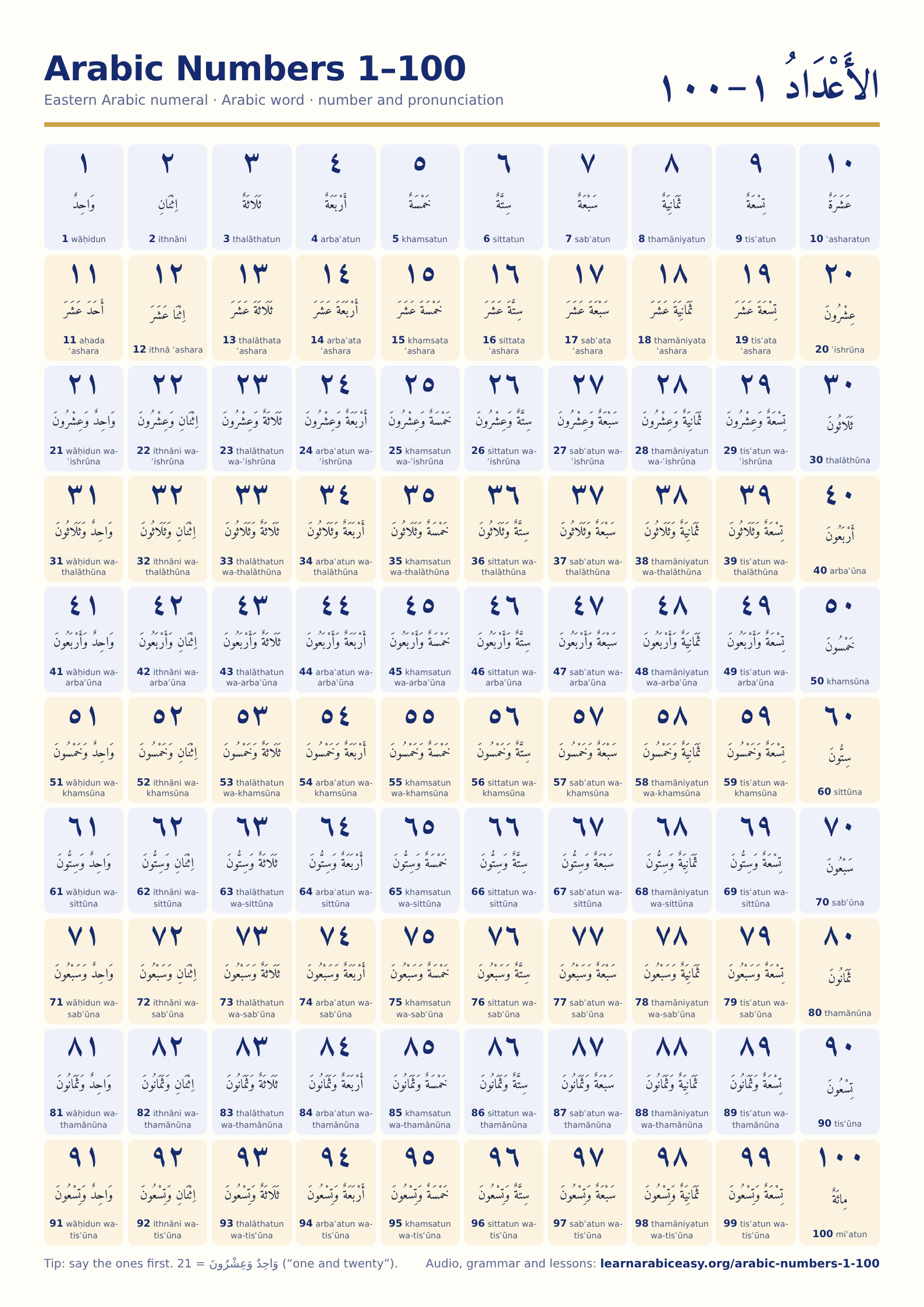
Printable Arabic numbers chart
All 100 numbers on one A4 page: the Arabic digit, the Arabic word with vowels, and the pronunciation. Print it for your wall, your desk or your classroom.
You may print and share it. A link back to this page is always appreciated.
Frequently asked questions
How do you say 100 in Arabic?
100 is مِائَةٌ (miʾatun). It is also spelled مِئَةٌ; the alif in مِائَةٌ is not pronounced. 200 is مِائَتَانِ (miʾatāni).
Are Arabic numbers written right to left?
Arabic words are written right to left, but the digits of a number are written left to right, just like in English. So ١٢٣ is 123. When you say a number like 21 out loud, you say the ones first: wāḥidun wa-ʿishrūna, “one and twenty”.
How do you say 21 in Arabic?
21 is وَاحِدٌ وَعِشْرُونَ (wāḥidun wa-ʿishrūna), literally “one and twenty”. All numbers from 21 to 99 work this way: ones, then wa (and), then the tens.
What is zero in Arabic?
Zero is صِفْرٌ (ṣifrun) and is written as a dot: ٠. The English words “zero” and “cipher” both come from ṣifr.
What is the difference between Arabic numerals and Eastern Arabic numerals?
The digits 0–9 used in English are called Arabic numerals because Europe learned them from Arabic books. In most Arab countries in the Middle East, people write ٠١٢٣٤٥٦٧٨٩ (Eastern Arabic numerals). In North Africa, 0–9 are common.
Why is it ثَلَاثَةُ كُتُبٍ but ثَلَاثُ بَنَاتٍ?
From 3 to 10, the number takes the opposite gender of the singular noun. كِتَابٌ (book) is masculine, so the number gets ة: ثَلَاثَةُ كُتُبٍ. بِنْتٌ (girl) is feminine, so the number has no ة: ثَلَاثُ بَنَاتٍ.
Is 2 in Arabic ithnān or ithnayn?
Both are correct. اِثْنَانِ (ithnāni) is the basic form you use when counting. اِثْنَيْنِ (ithnayni) is used after a preposition or as an object in Classical Arabic, and most spoken dialects use it all the time.